


There’s been a lot discuss not too long ago – particularly amongst politicians – about productiveness. And for good cause: Australia’s labour productiveness progress sits at a 60-year low.
To deal with this, Prime Minister Anthony Albanese has convened a productiveness spherical desk subsequent month. This may coincide with the discharge of an interim report from the Productiveness Fee, which is taking a look at 5 pillars of reform. Certainly one of these is the function of knowledge and digital applied sciences, together with synthetic intelligence (AI).
This will probably be music to the ears of the tech and enterprise sectors, which have been enthusiastically selling the productiveness advantages of AI. In actual fact, the Enterprise Council of Australia additionally mentioned final month that AI is the one biggest alternative in a era to elevate productiveness.
However what do we actually find out about how AI impacts productiveness?
What’s productiveness?
Put merely, productiveness is how a lot output (items and providers) we are able to produce from a given quantity of inputs (equivalent to labour and uncooked supplies). It issues as a result of increased productiveness sometimes interprets to the next way of life. Productiveness progress has accounted for 80% of Australia’s earnings progress over the previous three a long time.
Productiveness could be considered particular person, organisational or nationwide.
Organisational productiveness is how properly an organisation achieves its targets. For instance, in a analysis organisation, what number of top-quality analysis papers are produced?
Nationwide productiveness is the financial effectivity of a nation, usually measured as gross home product per hour labored. It’s successfully an mixture of the opposite varieties. However it’s notoriously tough to trace how modifications in particular person or organisational productiveness translate into nationwide GDP per hour labored.
AI and particular person productiveness
The nascent analysis inspecting the connection between AI and particular person productiveness reveals blended outcomes.
A 2025 real-world examine of AI and productiveness concerned 776 skilled product professionals at US multinational firm Procter & Gamble. The examine confirmed that people randomly assigned to make use of AI carried out in addition to a workforce of two with out. An analogous examine in 2023 with 750 consultants from Boston Consulting Group discovered duties have been 18% quicker with generative AI.
A 2023 paper reported on an early generative AI system in a Fortune 500 software program firm utilized by 5,200 buyer help brokers. The system confirmed a 14% enhance within the variety of points resolved per hour. For much less skilled brokers, productiveness elevated by 35%.
However AI doesn’t all the time enhance particular person productiveness.
A survey of two,500 professionals discovered generative AI really elevated workload for 77% of staff. Some 47% mentioned they didn’t know methods to unlock productiveness advantages. The examine factors to boundaries equivalent to the necessity to confirm and/or appropriate AI outputs, the necessity for AI upskilling, and unreasonable expectations about what AI can do.
A current CSIRO examine examined the day by day use of Microsoft 365 Copilot by 300 staff of a authorities organisation. Whereas the bulk self-reported productiveness advantages, a sizeable minority (30%) didn’t. Even these staff who reported productiveness enhancements anticipated larger productiveness advantages than have been delivered.

Prime Minister Anthony Albanese has convened a productiveness spherical desk in August.
Lukas Coch/AAP
AI and organisational productiveness
It’s tough, if not inconceivable, to attribute modifications in an organisation’s productiveness to the introduction of AI. Companies are delicate to many social and organisational components, any considered one of which could possibly be the explanation for a change in productiveness.
However, the Organisation for Financial Co-operation and Improvement (OECD) has estimated the productiveness advantages of conventional AI – that’s, machine studying utilized for an industry-specific process – to be zero to 11% on the organisational degree.
A 2024 abstract paper cites impartial research exhibiting will increase in organisational productiveness from AI in Germany, Italy and Taiwan.
In distinction, a 2022 evaluation of 300,000 US corporations didn’t discover a vital correlation between AI adoption and productiveness, however did for different applied sciences equivalent to robotics and cloud computing. Possible explanations are that AI hasn’t but had an impact on many corporations, or just that it’s too onerous to disentangle the affect of AI given it’s by no means utilized in isolation.
AI productiveness will increase also can generally be masked by extra human labour wanted to coach or function AI techniques. Take Amazon’s Simply Stroll Out know-how for outlets.
Publicly launched in 2018, it was supposed to cut back labour as buyer purchases can be absolutely automated. However it reportedly relied on hiring round 1,000 staff in India for high quality management. Amazon has labelled these experiences “erroneous”.
Extra usually, take into consideration the unknown quantity (however probably thousands and thousands) of individuals paid to label information for AI fashions.
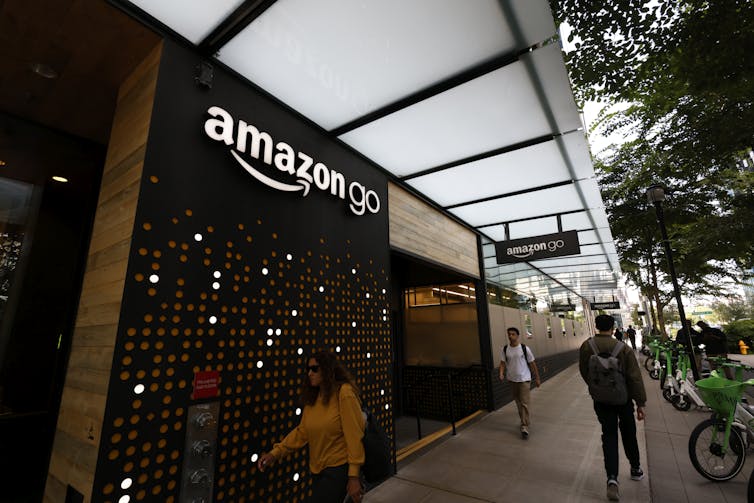
Amazon’s Simply Stroll Out know-how supposed to cut back labour as buyer purchases can be absolutely automated.
John G. Mabanglo/EPA
AI and nationwide productiveness
The image at a nationwide degree is even murkier.
Clearly, AI hasn’t but impacted nationwide productiveness. It may be argued that know-how developments take time to have an effect on nationwide productiveness, as corporations want to determine methods to use the know-how and put the mandatory infrastructure and abilities in place.
Nevertheless, this isn’t assured. For instance, whereas there may be consensus that the web led to productiveness enhancements, the consequences of cell phones and social media are extra contested, and their impacts are extra obvious in some industries (equivalent to leisure) than others.
Productiveness isn’t simply doing issues quicker
The frequent narrative round AI and productiveness is that AI automates mundane duties, making us quicker at doing issues and giving us extra time for artistic pursuits. This, nonetheless, is a naive view of how work occurs.
Sooner isn’t all the time higher. Typically, we have to decelerate to be extra productive. That’s when nice concepts occur.
Think about a world wherein AI isn’t merely about rushing up duties however proactively slows us down, to provide us area to be extra progressive, and extra productive. That’s the true untapped alternative with AI.
