


This piece accommodates spoilers for In the direction of Zero.
Agatha Christie, a middle-class English crime author who most well-liked to be referred to as a housewife, is the world’s bestselling novelist. Since her demise in 1976, her work has been translated into over 100 languages and tailored for cinema, TV and even video video games.
Her writing is characterised by its cheerful readability and ruthless dissection of hypocrisy, greed and respectability. Christie is fascinated by energy and its abuse, and explores this via the skilful deployment of recognisable character varieties. The suspects in her books are usually not simply there for the puzzle – in addition they exemplify the attitudes, beliefs and assumptions that formed Twentieth-century British society.
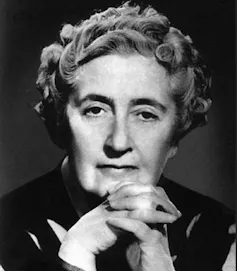
Agatha Christie in 1958.
Wikipedia
If we wish to know concerning the mid-century “manosphere”, then, there isn’t a higher place to look than within the fiction of Agatha Christie. What did masculinity imply to this author, and would we recognise it within the gender varieties and beliefs of as we speak? Some solutions is likely to be discovered via the latest BBC adaptation of In the direction of Zero, which confronts viewers with a spread of dysfunctional male varieties.

In search of one thing good? Reduce via the noise with a fastidiously curated collection of the most recent releases, stay occasions and exhibitions, straight to your inbox each fortnight, on Fridays. Join right here.
Chief amongst these is Thomas Royde, a neurotic twitching determine pushed to breakdown by the disgrace of getting his phrase doubted. Gaslit by his pathologically excellent cousin Nevile, Thomas has been dispatched to the colonies, the place he has compounded his accidents via monetary failure. Broke and damaged, the difference imagines him returning to the household house with trauma fairly actually written on his physique.
This isn’t the Thomas Royde of Christie’s authentic 1944 novel. That determine was stoic, silent and completely able to managing his failure to stay as much as the spectacular masculinity of cousin Nevile. Christie’s Thomas might have regretted his romantic losses and bodily limitations, however the thought of exposing his ache in public would have horrified him.
This isn’t a case of repression; quite it speaks to a world during which ache is revered, however merely not mentioned. Thomas’s buddies, we’re informed, “had learned to gauge his reactions correctly from the quality of his silences”. The stoical man of few phrases is a recurrent sort inside Christie’s fiction. It’s a mode of masculinity of which she approves – even whereas poking enjoyable at it – and one recognised by her mid-Twentieth century viewers.
These are males who embody splendid British middle-class values: regular, dependable, resilient, modest, good humoured and infinitely wise. They discover their fictional reward in glad unions, generally with wise ladies, generally with vibrant younger issues who profit from their calm assurance.
Christie additionally depicted extra harmful male varieties – engaging adventurers who is likely to be brave, or reckless and lethal. These charismatic figures current a troubling mode of masculinity in her fiction, from the effortlessly charming Ralph in The Homicide of Roger Ackroyd (1926), to Michael Rogers, the all too persuasive narrator of Infinite Evening (1967).
Superficially, these two kinds of males is likely to be mapped onto Christie’s personal experiences. Her autobiography means that she was irresistibly drawn to one thing unusual and inscrutable in her first husband, Archie. Against this, her second husband, the archaeologist Max Mallowan, introduced friendship and shared pursuits.
But whereas it’s doable to see biographical resonances in these varieties, it’s equally necessary to recognise them as a part of a middle-class world view that set limits on acceptable masculinities. In my ebook, Agatha Christie: A Very Brief Introduction, I discover these limits, inspecting a cultural local weather riven with contradictions.
A distinct time
Mid-Twentieth century tradition insisted that males be articulate when discussing public issues – science, politics, sport – however those that prolonged this to the feelings have been to not be trusted. They have been seen to be glib, silly or probably harmful.
British masculinity acts quite than talks and does a good job of labor. Consequently, work itself is an important dimension of man-making in Christie’s novels, and within the fiction of contemporaries like Nigel Balchin, Hammond Innes and Nevil Shute.
These writers witnessed the conflicting pressures on males, anticipated to be each troopers and residents, able to fight and home breadwinning. They noticed the harm attributable to warfare, unemployment and the lack of father figures. However the reply wasn’t speaking. Relatively, the most effective medication for wounded masculinity was the self-respect that comes with doing an excellent day’s work.
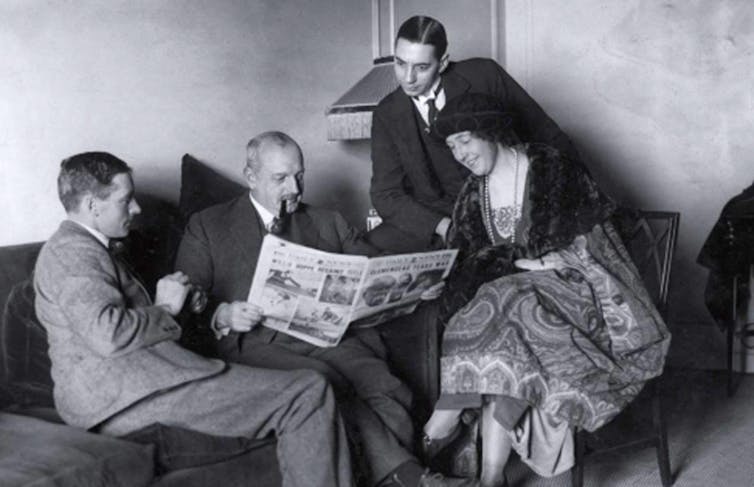
Christie’s husband Archie (left) with Christie on her 1922 British Empire Expedition Tour.
CBW / Alamy
This ideology nonetheless resonates inside understandings of “healthy” masculinity, however there are limits to the issues that may be solved via a companionable post-work pint. Which brings us again to the BBC’s In the direction of Zero. Up to date diversifications typically converse to the preoccupations of their second, and the plot is pushed by one man’s all-consuming hatred of his ex-wife.
With apologies for plot spoilers, excellent Nevile seems to be an ideal misogynist, scheming in opposition to the lady who has – to his thoughts – humiliated him. However the world of his hatred is a great distance from the net “manosphere” of our modern age.
Fairly except for the technological gulf separating the eras, Christie doesn’t think about misogyny as an abusive mass phenomenon, a set of echo chambers which determine males because the victims of feminism. Relatively, Nevile, like all Christie’s murderers, kills for causes that may clearly be outlined, detected and articulated: he’s an remoted madman, not a cultural phenomenon.
In the direction of Zero’s topicality – its preoccupation with celeb, resentment of ladies and a manipulative gaslighting villain – does a lot to clarify its adaptation, but it surely doesn’t account for the unconventional revision of Thomas Royde. Is it a sign that stoicism is out of vogue? Or just a need to transform Christie’s cool-tempered fictions into melodramas applicable for a social-media age?
Regardless of the pondering, there’s a acquainted comfort for Thomas’s ache. He may not get the woman of his desires, however he does get one thing higher: a gradual, dependable lady whose modest virtues illustrate that, in Christie’s world, “ideal masculinity” is unexpectedly non-binary. Ladies could be simply as stoic, reserved and resilient as males.
Christie’s “manosphere”, then, has its share of haters, however they’re remoted figures compelled to disguise their resentments. Additionally they, incessantly, meet premature ends – another excuse why Christie stays a bestseller to today.
This text options references to books which were included for editorial causes, and will comprise hyperlinks to bookshop.org. If you happen to purchase one thing, The Dialog UK might earn a fee.
